The Geometry of Trust: Subtle Integration of Traditional Architectural Motifs to Attract MENA Investors
Entering the Middle East and North Africa (MENA) market requires more than just a solid business plan and a compelling product; it demands a profound understanding of cultural nuances. When participating in international trade shows and corporate exhibitions in business hubs like Dubai, Abu Dhabi, or Riyadh, your physical space speaks volumes before you even utter a single word. For MENA investors, trust is the absolute foundational currency of any successful business relationship.
One of the most powerful, yet frequently overlooked, ways to establish this crucial trust is through the spatial environment you create. This article explores how the subtle integration of traditional architectural motifs in your exhibition stand design can significantly impact investor perception, creating a subconscious bridge of familiarity, profound respect, and ultimate trust.
Understanding the MENA Investor Mindset
Investors in the MENA region deeply value heritage, legacy, and cultural continuity. While they are highly forward-looking, driving futuristic smart cities, and heavily investing in next-generation technologies, they remain firmly rooted in their historical traditions. An exhibition space that completely ignores these cultural touchpoints might feel entirely alien, overly sterile, or purely transactional.
Conversely, a design that respectfully nods to local heritage signals that a company has done its homework. It shows a long-term commitment to the region that goes well beyond immediate financial gain. This is exactly where the concept of “The Geometry of Trust” comes into play. By utilizing specific spatial proportions, historical patterns, and architectural nods, international brands can evoke an immediate sense of reliability, hospitality, and mutual respect.
The Power of Traditional Architectural Motifs
To effectively attract MENA investors, it is essential to understand which architectural motifs resonate most deeply and what specific psychological triggers they activate in a business setting.
Mashrabiya: The Balance of Privacy and Transparency
The Mashrabiya is a traditional projecting oriel window enclosed with carved wood latticework. Historically, it allowed a cooling breeze to flow through a home while fiercely protecting the privacy of its inhabitants from the outside world.
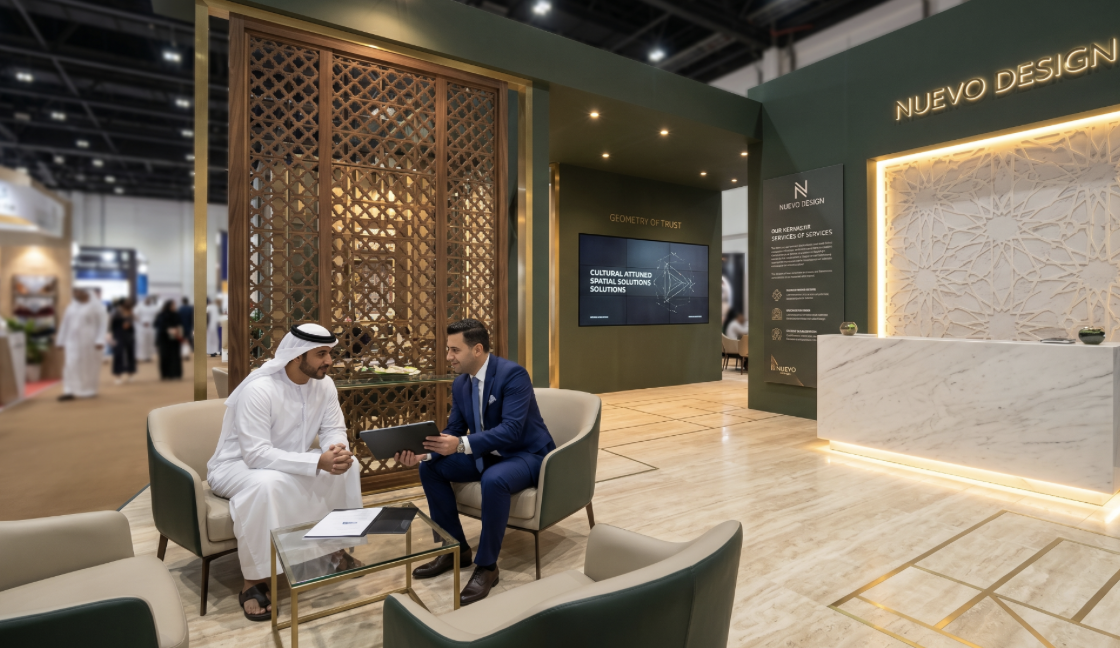
In a modern business and exhibition context, the Mashrabiya motif can be subtly integrated into walls, VIP partitions, or meeting room dividers.
- Psychological impact: It instantly communicates a profound respect for privacy—a highly valued and fiercely protected concept in Arab business culture. It allows investors to feel secure and discreet during high-level negotiations, while still maintaining a visual connection to the broader energy of the exhibition environment.
Arabesque and Geometric Patterns: Infinite Connectivity
Islamic art and architecture are globally renowned for their complex, interlacing geometric patterns. These designs are not merely decorative elements added for aesthetic appeal; they carry deep mathematical and philosophical meaning, often representing the infinite nature of the universe, cosmic order, and the interconnectedness of all things.
- Psychological impact: When used subtly in premium floor designs, acoustic wall panels, or subtle digital displays, geometric arabesque conveys meticulous attention to detail, underlying stability, and an enduring, reliable structure. For an investor analyzing a potential venture, these are highly desirable traits in a future business partner.
The Sahn (Internal Courtyard): The Epicenter of Hospitality
Traditional Middle Eastern homes, palaces, and public buildings almost universally feature a central courtyard known as a Sahn. It is a vital place of gathering, natural cooling, and, most importantly, legendary hospitality.
- Psychological impact: Designing an exhibition space around a central, welcoming hub closely mimics the Sahn. It immediately changes the dynamic of the interaction from an aggressive “sales pitch” to a “welcoming conversation.” Offering a comfortable, premium seating area right in the center of your stand demonstrates traditional hospitality, making regional investors feel valued as honored guests first, and business prospects second.
Subtlety is Key: Modern Interpretations for B2B Environments
The absolute most critical rule when utilizing traditional architectural motifs in the modern exhibition industry is subtlety. Overt, literal, or theme-park-style representations can easily backfire, appearing disingenuous, culturally insensitive, or simply outdated. The ultimate goal is seamless integration, not historical replication.
Modern Material Selection
Instead of using traditional heavy carved wood for a Mashrabiya pattern, consider executing the motif in sleek, modern, high-end materials. Laser-cut brushed aluminum, frosted architectural glass, or even 3D-printed sustainable polymers can effortlessly bring a traditional centuries-old pattern into the 21st century. This sophisticated blend of the old and the new perfectly mirrors the current economic landscape of rapidly advancing cities like Dubai.
Lighting as an Architectural Element
Lighting is a phenomenal, non-intrusive tool for subtle cultural integration. Instead of building physical partitions that take up valuable floor space, you can use advanced projection mapping or custom gobos to cast moving geometric shadows across a minimalist, pristine surface.
“Light does not just illuminate a physical space; it dictates its emotional temperature. In MENA-focused design, warm, patterned architectural lighting can instantly transform a sterile corporate booth into a trusted sanctuary for high-level deals.”
Practical Tips for Integrating Motifs in Exhibition Design
If you want to ensure your upcoming exhibition presence successfully attracts regional stakeholders and high-net-worth investors, carefully consider these practical, actionable guidelines:
- Research Regional Variations: The MENA region is vast and absolutely not monolithic. Architectural motifs in the UAE differ slightly from those in Saudi Arabia, Qatar, or Morocco. Tailor your subtle design nods to the specific geographic location of your trade show.
- Prioritize Flow Over Density: Traditional architecture in the region heavily emphasizes spaciousness, high ceilings, and unhindered airflow. Avoid cluttering your stand with too much product display or dense furniture. Allow the space—and your guests—to breathe.
- Focus on Tactile Quality: High-end investors will subconsciously judge the overall quality of your business by the tactile quality of your presentation. Use premium, authentic finishes that feel substantial and good to the touch, such as real stone, heavy metals, and high-thread-count fabrics.
- Integrate Technology Seamlessly: The MENA market loves cutting-edge tech. However, embed digital screens and interactive AR/VR elements within architectural structures rather than mounting them as clumsy afterthoughts.
You can observe real-world examples of how premium modern materials and thoughtful cultural layouts are successfully combined by exploring our successful design portfolio, which showcases culturally attuned, high-impact spatial solutions tailored for the Middle Eastern market.
Frequently Asked Questions (FAQ)
Does my business need to be originally from the Middle East to use these architectural motifs?
Absolutely not. In fact, when international companies from Europe, Asia, or the Americas respectfully integrate local motifs into their branding and physical presence, it often leaves a significantly stronger impression. It clearly demonstrates a high level of dedication, thorough research, and profound respect for the local market, bridging cultural gaps instantly.
Will subtle geometric motifs really make a tangible difference to a strict investor’s financial decision?
While investors ultimately make their final decisions based on hard data, ROI, and market viability, they initially choose who they want to sit down and do business with based on human relationships and baseline trust. An environment that subconsciously signals cultural respect and corporate stability can be the very deciding factor in whether a multi-million dollar conversation begins at all.
How can I ensure the cultural design doesn’t look outdated or cliché?
The secret lies in design abstraction. Take the core mathematical geometry of a traditional Arabesque pattern and scale it up massively, change its traditional material to something futuristic, or use it asymmetrically. Modern, stark minimalism paired with just a single, strong cultural motif is a highly effective, premium strategy used by top luxury brands in the region.
Build Trust with Expert Design
Succeeding in the highly competitive MENA market requires a deeply nuanced approach where every single detail of your brand’s physical presence is meticulously optimized for cultural resonance and professional credibility. “The Geometry of Trust” is far more than just a passing design philosophy; it is a highly strategic business tool designed to accelerate relationship building and secure investments.
Don’t leave your vital first impression to chance. If you are preparing for an upcoming trade show, major expo, or corporate exhibition in the UAE or the wider region, partner with seasoned experts who deeply understand the delicate balance of modern global innovation and traditional regional respect. Subscribe to our design newsletter for continuous insights into Middle Eastern market trends, or contact our design experts today to start planning an exhibition space that truly speaks the language of MENA investors.