The Psychology of Lighting in Exhibition Stand Design: Attracting More Foot Traffic
When planning a high-impact corporate presence at a major trade show, marketing teams and brands naturally obsess over architectural layouts, bold tension-fabric graphics, and expensive digital displays. Yet, one of the most powerful, influential, and frequently underestimated elements of spatial design is lighting. Exhibition stand lighting design is not merely a practical, utilitarian necessity to ensure attendees can see your brochures; it is a profound psychological tool that subconsciously dictates how people feel, where their eyes are drawn, and ultimately, whether they decide to step into your space or walk right past.
Understanding and implementing advanced trade show lighting techniques can literally be the difference between an empty, uninviting booth and a highly profitable, crowded one. In this comprehensive guide, we will explore the science of illumination, how to use creative booth lighting Dubai to manipulate spatial perception, and proven strategies to maximize your foot traffic and event ROI.
The Phototropic Effect: Why Light Dictates Foot Traffic
To use light effectively as a marketing tool, we must first understand how human beings react to it on a deep, subconscious biological level.
Humans are naturally phototropic. Much like moths drawn to a flame, our visual attention and physical bodies are instinctively drawn toward the brightest, most well-lit areas in our immediate field of vision. In a massive, visually chaotic, and often dimly or unevenly lit exhibition hall-such as the massive pavilions at the Dubai World Trade Centre or ADNEC-a brightly and strategically lit stand acts as a visual beacon.
However, developing a strategy to attract visitors to the exhibition effectively isn’t just about turning up the brightness to blinding, uncomfortable levels. The quality, direction, and color temperature of the light trigger distinct psychological and physiological responses that can either invite people in or push them away.
Understanding Color Temperature and Emotional Response
Lighting is scientifically measured in Kelvins (K), which dictates its visual color temperature. Choosing the correct temperature is the most crucial step in setting the psychological tone and emotional baseline of your exhibition booth.
Warm Light (2700K – 3000K): Comfort and Trust
Warm lighting emits a yellowish, soft glow akin to an evening sunset or a cozy luxury living room. Psychologically, warm light lowers the human heart rate, reduces visual stress, and creates an intimate, highly welcoming atmosphere.
- Best Use Cases: This temperature is absolutely perfect for private majlis areas and hospitality zones, where your primary goal is to encourage visitors to sit down, drink coffee, relax, and engage in long-term relationship-building conversations.
Neutral to Cool Light (4000K – 5500K): Energy and Precision
Cool light mimics bright, mid-day natural daylight. It feels highly energetic, immaculately clean, modern, and alert. It sharpens contrast and forces the brain to pay attention.
- Best Use Cases: Cool lighting is ideal for showcasing high-tech SaaS products, sterile medical equipment at healthcare expos, or illuminating fast-paced interactive gamification screens. It signals innovation and clarity.
“Masterful lighting design is entirely invisible to the average attendee. They won’t compliment your fixtures, but they will stay at your booth 15 minutes longer because the environment simply ‘feels right’.”
The Critical Role of Color Rendering Index (CRI)
Beyond temperature, professional designers look at the Color Rendering Index (CRI). Measured on a scale from 0 to 100, CRI dictates how accurately a light source reveals the true colors of an object compared to natural sunlight.
If you are showcasing physical products—whether it’s high-end fashion garments, automotive parts, or fresh food products at Gulfood—you must insist on lighting fixtures with a high CRI of 90 or above. A low CRI will make your vibrant brand colors look dull, muddy, and washed out, immediately lowering the perceived quality of your brand in the eyes of the consumer.
Advanced Trade Show Lighting Techniques: The Layered Approach
A professional, high-end lighting layout relies on a strict layered approach. Relying solely on the venue’s standard overhead hall lights will make your custom stand look flat, generic, and thoroughly uninviting.
Layer 1: Ambient Illumination
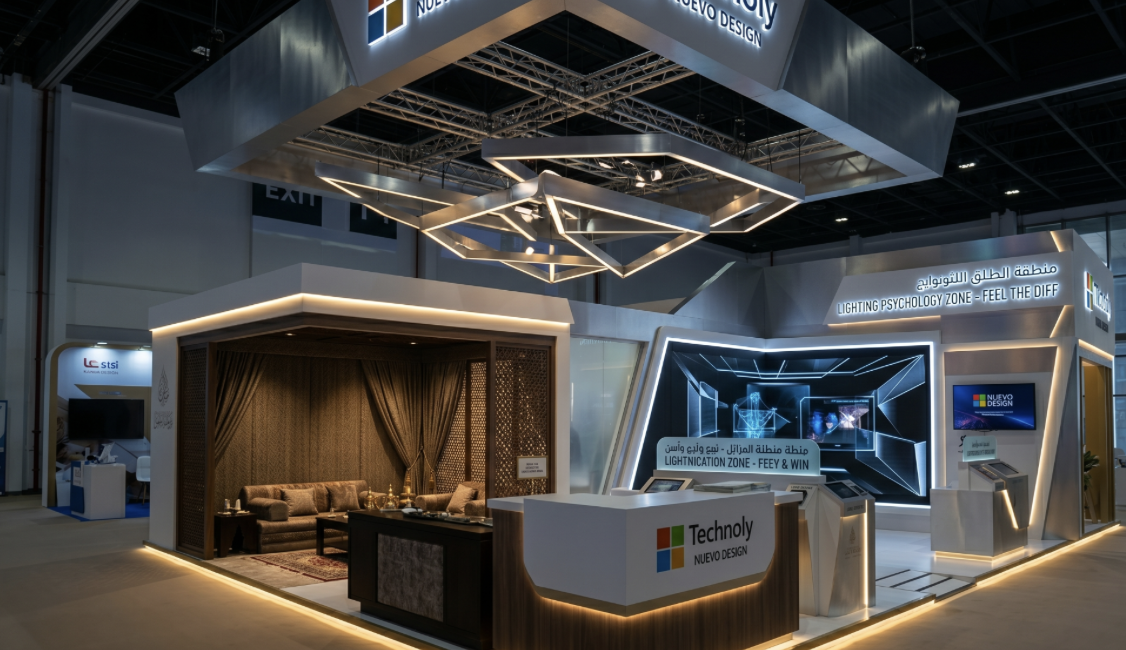
This is the foundational base layer of light that illuminates the entire stand safely and evenly. Soft, diffused ambient lighting ensures that harsh shadows are minimized and the space feels open and physically accessible. Large overhead truss systems rigged with diffused LED wash panels work best for creating this comfortable base layer.
Layer 2: Strategic Accent and Spotlighting
This is the layer where you dictate the visual hierarchy of your booth. Use narrow-beam LED spotlights to dramatically highlight your newest hero products, 3D architectural logos, or primary marketing messages. By creating a deliberate, high contrast between the softer ambient light and the intense spotlight, you literally force the human eye to look exactly where you want it to look.
Layer 3: Dynamic and Decorative Lighting
This final layer adds unique personality and brand flair. It includes aesthetic elements like custom neon signs, vintage pendant lamps hanging over a meeting table, or edge-lit acrylic displays. This layer isn’t about illuminating the space; it’s about solidifying your brand’s visual identity.
Creative Booth Lighting Dubai: Regional Market Trends
In the highly competitive Middle Eastern exhibition market, brands are constantly pushing the boundaries of spatial design to capture attention.
- Backlit Tension Fabrics: This is a dominant trend in modern stand design. By placing dense arrays of LED panels directly behind printed fabric walls, the graphics literally glow from within. This creates a seamless, high-end aesthetic that is highly visible from across the exhibition hall.
- Kinetic and Programmable LEDs: Static lighting is being replaced by motion. Programmable LED strips that gently pulse, chase, or change color catch the peripheral vision of attendees walking quickly down the aisle. Because human biology is hardwired to notice movement, dynamic lighting is an incredibly potent tool for drawing a crowd.
Common Lighting Mistakes That Repel Attendees
While exceptional lighting will effortlessly draw people in, poor lighting execution will actively drive your highly qualified leads away. Avoid these critical pitfalls:
- Blinding Glare: Ensure all overhead spotlights and track lights are angled correctly (usually pointed straight down or at a steep angle toward a solid wall). If a bright light is shining directly into the eyes of a visitor walking down the aisle, they will instinctively look away, lower their head, and walk entirely past your booth.
- Unmanaged Heat: Traditional halogen or incandescent lights generate massive amounts of physical heat. In a crowded booth, this can make the space sweaty, claustrophobic, and unbearable, causing visitors to leave your stand abruptly. Always insist your agency uses 100% LED fixtures, which run completely cool.
- Screen Washout: If you are using digital displays or LED video walls, ensure your ambient lighting isn’t causing severe glare on the screens, rendering your expensive video content impossible to read.
Frequently Asked Questions (FAQ)
Q: Is it really worth the high cost of paying for additional overhead lighting rigging from the venue? A: Almost always, yes. Paying for an overhead truss lighting rig gives your design team complete, 360-degree control over your booth’s visual environment. It allows you to completely bypass the often dull, yellow, and uneven lighting provided by the exhibition hall itself.
Q: Can clever lighting techniques make my small exhibition booth look bigger? A: Yes, absolutely. Brightly illuminating the back walls of your stand (a technique known as wall-washing) and using cooler-toned lights can create a powerful psychological illusion of depth. This makes a confined, small 3×3 meter space feel significantly larger, airier, and less claustrophobic.
Q: How early in the design process should we plan the lighting? A: Lighting must be planned concurrently with the architectural layout. If you wait until the walls are already designed to think about lights, you will be forced to use clunky, visible fixtures rather than sleek, integrated lighting solutions.
Conclusion
Exhibition stand lighting design is equal parts precise technical science, applied psychological theory, and high art form. By strategically understanding color temperature and utilizing a meticulously planned layered approach of ambient, accent, and decorative lighting, you can completely control the visual hierarchy of your physical space.
When executed correctly, professional lighting allows you to evoke specific, desired emotional responses from your target audience and, ultimately, dramatically increase your foot traffic and lead generation potential.
Don’t leave your brand in the dark at your next major industry event. Contact our exhibition design specialists today to discover how we can masterfully illuminate your custom stand and make your brand the undeniable, glowing focal point of the exhibition hall.